
Jennifer Busch

Lessons Learned

Perkins+Will envisions a modular future for green education environments with Sprout Space™, part of the National Building Museum’s Green Schools Exhibit

In 2009, the Atlanta office of Perkins+Will entered Architecture for Humanity’s Open Architecture Network Challenge, which focused attention on poor education standards worldwide, and called upon the global design community to envision the classroom of the future. A concept designed by P+W’s Allen Post took the top award in the competition’s modular category, thus validating the firm’s lessons learned from years of experience designing sustainable K-12 school environments.

0582_Kittner_20130225_7649And6moreEnhancer-Edit

Perkins + Will’s award-winning, sustainable modular classroom, Sprout Space™, was built on the west lawn of the National Building Museum in Washington, D.C., as part of the NBM’s 10-month-long Green Schools exhibition.

“There are 250,000 modular classrooms in the United State, which means that roughly 7.5 million kids are learning in these spaces,” says Post, noting that traditional modular classrooms have long been disliked by Perkins+Will’s education practice. As the firm has designed and completed schools around

the country, its designers have lamented to see LEED-certified projects supplemented with sub-standard modular classroom buildings as school populations grew. “At best they are marginal. At worst they are unhealthy,” Post says.

The Architecture for Humanity competition offered Post the opportunity to devise a better solution—one that, four years later, finally has been realized in built form on the west lawn of the National Building Museum in Washington, D.C., as part of the NBM’s Green Schools, a 10-month long program and exhibition focused on greening the learning environment. Trademarked Sprout Space™, the sustainable modular classroom of the future is also finding its way into the real world as a pre-engineered building solution being marketed to the education sector through presenting sponsor Triumph Modular, and others.

According to Post, “healthy, sustainable, flexible” are the three pillars of the Sprout Space™ concept, with high indoor air quality, good acoustics, natural light, and efficient and functional space being the highest design priorities. In addition to featuring building materials, furniture, and finishes that are formaldehyde-free, eliminate harmful off-gassing, and include recycled content, Sprout Space™ incorporates glass walls and clerestories to allow daylight to flow in, uses energy- and water-efficient building systems (including a rainwater collection system), and employs a dynamic plan that can accommodate various teaching styles, seating configurations, and even outdoor learning opportunities—all in a unit comparable in size to a traditional double-wide modular classroom trailer.

T7424x4924-257_58_59_60_61_62_63Natural

“Healthy, Sustainable, Flexible” are the three pillars of the Sprout Space™ concept, which was designed by Perkins +Will to ensure high indoor air quality, good acoustics, ample natural light, and a dynamic plan that can accommodate various teaching styles and seating configurations, as well as outdoor learning space.

As Post notes, many manufacturing partners contributed to the success of Sprout Space™, including Interface, which supplied carpet tile for the entry and breakout areas. “We vetted all our partners carefully to make sure we were working with the leaders on sustainability in the industry,” notes Post. Interface’s contribution is multi-functional, serving as a walk-off carpet, providing a visual shift from installed hard surface flooring to indicate a spatial transition, and providing a softer flooring surface for students to sit in the breakout area.

In addition to being a feature of the Green Schools exhibit, Sprout Space is actually functioning as a working classroom for school visits during weekday morning hours,

T7424x4924-131_2_3_4_5_6_7Natural

Sprout Space™ designer Allen Post, from the Atlanta office of Perkins+Will, sought industry partners that are leaders in sustainability to help make the construction and interior fit out of the modular classroom space possible. Interface was tapped to provide the carpet tiles for entry and breakout areas.

According to the National Building Museum, “This 3-dimensional teaching tool is the first net-zero energy, high-performance, modular classroom available for distribution at a national level. Sprout Space™ integrates many active and passive green strategies in order to reduce operating costs, increase student and teacher satisfaction, and provide a healthier indoor learning environment.”

Interface also contributed carpet tile to the main part of the Green Schools exhibit inside the NBM, in a gallery devoted to hands-on learning about sustainable building and design materials for the K-12 education sector.

[Facebook] [LinkedIn] [Twitter] [Email]
Posted in Category Design Inspirations | Leave a comment

Jennifer Busch

We Are One

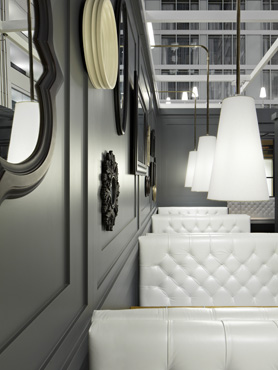
Gallerie Bar & Bistro detail at Hilton Columbus Downtown Atrium in Columbus, Ohio. Photographed by Nathan Kirkman

Gallerie Bar & Bistro detail at Hilton Columbus Downtown Atrium in Columbus, Ohio. Photographed by Nathan Kirkman

In the 10 years since they founded their young design firm, rising hospitality designers Lisa Simeone and Gina Deary of Chicago-based Simeone Deary Design Group can count such projects as Chicago’s elegant Elysian Hotel (now the Waldorf Astoria Chicago), the Hilton Dallas Park Cities, and the JW Marriott Indianapolis to their credit. Currently they are working on Loews hotels in Chicago, Nashville, Tenn., and Orlando, a new restaurant concept with Richard Melman of Lettuce Entertain You fame, and a JW Marriott and a Westin for White Lodging in the red hot city of Austin, Texas. They’ve also started a residential design studio. Interface talked to this busy pair—who approach their work as a team—about the formula for success behind their prospering firm, their fascination with technology, and the all-important role of design in the hospitality sector.

IF: How would you describe your design process?

LS & GD: After we meet with the client and understand their criteria, we do research on the location, the building architect…we dig into the property to find out what is going to make it grow in the community. For us a project is as much a branding and positioning exercise as it is an interior design assignment.

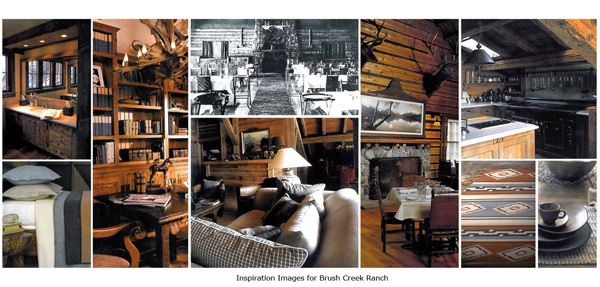
14 Brush Creek Ranch Inspiration ImagesWEB

Brush Creek Ranch inspiration images

We start our critical thinking by digging into the location, and then we create a concept that is really representative of what we are thinking. That’s when we get very creative. We open up our minds to what inspires us, and we filter all this through our story.
We make very succinct decisions around every element in every phase. This elevates us above trends, so we are creating a sense of place and not just a sense of currency.

IF: Where do you turn for inspiration?

LS & GD: Inspiration comes from everywhere! It comes from fashion, jewelry, metalwork, film noir, Hollywood. Anything we find in culture we can use. We have been inspired by Jane Austen, pin-up girls, architecture, nature. We are really into how people lived at certain times. For each project we run these ideas through the filter of our concept and see how things settle out.

IF: What do you enjoy most about your work?

GD: I most enjoy the people I work with, and watching them grow and mature, and thinking that Lisa and I are helping that happen. Also, I am exposed to so many people and places and ideas and things. It makes me a much better designer and helps me grow too.

LS: I am inspired every day working with such a creative group of people. We have such a sense of camaraderie here. Being inspired and inspiring other people is what gets me up every morning.

IF: What do you believe to be the primary value of good design to your clients?

LS & GD: Design is how our clients touch their customers. The experiences we create for them help them reap monetary benefits. Are clients seeing proof in the numbers? They are! If we do a great design, that design becomes a marketing tool.

IF: Is there anything in particular happening in the design world right now that inspires you?

LS & GD: Technology. It moves so fast. The doors are flung open on the things we are able to achieve. It has become a real vehicle for expressing ideas.

IF: What is

the biggest challenge facing the design profession today?

LS & GD: The biggest challenge is the speed at which projects are being built and financed. How do designers keep up with that? The creative process isn’t given enough time. Our own challenge is how to morph our process to be just as competitive and creative, and still fit into that excelled, demanding way of doing business.

IF: If you were able to give one piece of advice to young designers just starting out, what would it be?

18 Gina Deary HeadshotWEB2GD:
Everything is a learning experience. School opens the door but once you walk through that door there is a lot you still have to learn. Nothing is beneath you. Get every experience you can. And don’t be afraid to fail.

19 Lisa Simeone HeadshotWEB
LS:
Try to intern as much as possible. Understand the many different types of firms and facets of design. There is a lot of pressure to conform but be true to yourself. Don’t be timid. Let the bold idea out.

[Facebook] [LinkedIn] [Twitter] [Email]
Posted in Category Designer Spotlight | Leave a comment

Melissa Vernon

Clinton Global Initiative University Turns Ideas into Actions

Why should we care about anybody else? Former President Clinton believes that caring about others is imperative, “because we live in an interdependent world. Our fates are bound up together. If you want a future of shared prosperity, everybody has to be a part of it.”

On April 7th Interface chose to

be a part of creating the future by partnering with the Clinton Global Initiative to host a service project during the annual CGI University conference. Standing alongside hundreds of highly motivated college students from all 50 states and more than 70 countries, sharing stories of how they have tackled sustainability, was a humbling experience. To attend students must have developed a Commitment to Action, “a specific plan of action that addresses a pressing challenge on campus, in the community, or around the world.”

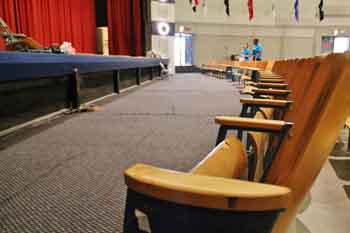
Gateway STEM High School, St. Louis. MO.

Gateway STEM High School, St. Louis. MO.

For weeks, volunteers from Washington University in St. Louis, MO, were busy preparing Gateway STEM High School, a St. Louis magnet school, for the service projects. A flurry of activity surrounded the school – old carpet was removed, painter’s tape lined the walls, supplies were stocked – anticipating the arrival of hundreds of student volunteers and a few VIP guests.

Chelsea and President Clinton kicked off the day with inspiring messages of the power of service and civic engagement. They highlighted the enormous employment opportunity for the American workforce in careers in energy efficiency, green schools, and retrofitting buildings. Gateway STEM high school integrates a strong academic curriculum of science, technology, engineering and math – skills needed for our current and future economy.

After two days of inspiring panel sessions, skill building breakout sessions, and top notch networking, hundreds of students joined in transforming Gateway High in a number of restorative projects around the school and grounds – painting, carpeting, garden construction, storage clean-out, and more.

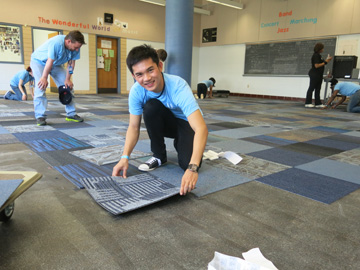
Interface’s Director of Sustainable Strategy, Melissa Vernon, and St Louis based Account Executives Dennis Upshaw and Katie Sweetin, led a motivated group of students installing carpet in the music room and college room. The students quickly learned the technique and really enjoyed their volunteer experience. Flooring Systems, a flooring dealer in St. Louis, donated their time to prep the floors and installed the auditorium carpet to have it looking great for President Clinton’s welcoming remarks.

carpet installationweb

From eyesore (and tripping hazard) to restored beauty.

The teachers and staff of Gateway High School were thrilled with the result. The previous carpet in the auditorium was a tripping hazard with wrinkles and duct tape everywhere. Principal Dr. Beth Bender commented, “I have literally had staff in tears and students just shocked at how great the carpet in the auditorium looks, as well as the college and band rooms. For those us of in public education, especially the poorer end of the spectrum, this makes a huge difference.”

In his thanks President Clinton commented, “I’d like to thank Interface carpet, which donated time and supplies to completely re-carpet this auditorium with environmentally friendly modular carpet tiles.” He also mentioned the great work of the USGBC and the Center for Green Schools.

The teachers shared that the students don’t receive many gifts. An upgrade to the building honors these individuals as valued members of society. As President Clinton voiced, “schools like Gateway are giving people a chance to climb up the ladder in this country… they’re [Gateway students] being given a chance to succeed in a world where the doors have been shut to many of their parents because they didn’t have those opportunities.”

Interface was proud to be a part of this special day for the CGIU team and to leave a legacy for the Gateway students.


[Facebook] [LinkedIn] [Twitter] [Email]
Posted in Category Sustainability | Leave a comment

Sarah Pelham

Hospitality Design Inspiration: Fuchsia Palette

 Be inspired by this compilation of some of our newest and most popular Interface Hospitality products.

Final_Hospitality_Fushia_Palette_InspirationWEB sizeColor, form and texture take center stage in this palette. Both whimsical and organic in feel, you’ll find very decorative pieces in this group with one pattern relating back to the highly decorated paisley motifs of ancient Persia.

Inspirations for the balance of the patterns were found in nature. Organic form and patterning play a large role in this grouping. Bring the outdoors inside with bursting pods, wispy grass and natural wood textures. The colors are fun and punchy and make a statement with a bold pink accent.


Final_Hospitality_Fushia_Palette_product w IDA. Product: Head Over Heels (Sheared), Pattern: M0871; B. Product: Head Over Heels (Sheared), Pattern: M0875; C. Product: Head Over Heels (Sheared), Pattern: M0875; D. Product: RMS506; E. Product: RMS 404, Color: A 40011; F. Product: Hip Over History, Pattern: M0941; G. Product:Head Over Heels (Sheared), Pattern: M0873

[Facebook] [LinkedIn] [Twitter] [Email]
Posted in Category Design Inspirations, Hospitality Design, Hospitality Palettes | Leave a comment

Nadine Gudz

Work Out

It’s a simple idea, with huge benefits: Spend 30 min outside for 30 days.  Interface Canada ran its own 30 x 30 challenge in September 2012 as a fun way to celebrate its 30th anniversary.  Here, my Q & A with Dr. Faisal Moola, Director General, Ontario and Northern Canada, David Suzuki Foundation sets the tone for round two, beginning this month. Reduce stress? Boost energy?  Improve productivity? Bring it on!

Q: What is the 30 x 30 Nature Challenge? How did it all start?

30x30_Joel Robison webThe concept of 30X30 was originally inspired by one of the Foundation’s Camp Suzuki leaders – Barry Freeman – who decided he needed to get outside more often. We began working with Your Brain on Nature co-author Dr. Alan Logan and Canada’s 30×30 Nature Challenge was born! I’m not sure if this is the official line at DSF now, but it was originally conceptualized by a Camp Suzuki (Rouge NP) participant Barry Freeman – assistant prof in and performance studies at UofT Scarborough.

The concept is really simple, we are inviting people from coast to coast during the month of May to commit to spending 30 minutes a day, for 30 days outside in nature. Our goal is to inspire Canadian’s to ‘cultivate a nature habit’ and enjoy all of the benefits nature can provide. The Challenge launched on Earth Day (April 22).

Q. Why is it important for people to stay connected to nature?

Over the last decade researchers have found what most of us know intuitively, there are countless benefits to time spent outdoors. Simply, connecting with nature is good for our heath and overall emotional and physical well-being. Numerous scientific studies have shown that being regularly immersed in a natural setting like a park, woodland or forest, can lower blood pressure, anxiety and stress levels, as well as boost immunity. ‘Green time’ has also been shown to reduce feelings of anger and depression, while increasing energy, creativity and attention span.

It’s no secret many of us spend our days in front of electronic screens and enjoy little interaction with nature.  There is an increasing body of scientific and medical evidence connecting outdoor activities in nature to increased mental and physical health. Take what you do inside — board games, books, a game of cards — outside. It just makes sense to create a nature movement and get people outdoors!

Getting your daily dose of nature is essential to maintaining a balanced, happy, active life for you and your family. Strap on your running shoes and go for a walk on your lunch, take your family on a hike or bike ride in your favorite green space after dinner. It’s that easy.

Q: Why is workplace engagement a focus of this year’s 30 x 30 nature challenge? Why should offices sign up?

The motivation comes from a recent study published by the World Economic Forum that shows how wellness can play a powerful role in employee engagement, organizational productivity, talent retention, creativity and innovation.

Living in the digital age, many of us spend our days in front of electronic screens and computers- this is particularly true for those of us working in offices. The cost of our high-tech, high-stress lives is very real for employees and employers: reduced productivity, lower job satisfaction and higher rates of absenteeism.

It’s been shown daily exposure to nature can improve concentration, and overall mental health and wellbeing. We’ve identified the need to introduce the challenge to businesses across Canada in an effort to transform office culture. We’ve developed a customized Toolkit for HR representatives so they promote the challenge in a fun, interactive way to their employees. The kit includes colourful posters, daily inspirational cards and an office copy of Your Brain on Nature.

Companies can sign up at www.davidsuzuki.org/30x30challenge. We encourage participants to share their stories with their friends and social networks, as well as submit photos of time spent outside in our weekly 30×30 Photo Contests throughout May.

Organize walking staff meetings, a pop-up picnic over the lunch hour, or an after work jog. These are simple and meaningful ways organizations can get everyone involved, and support employee wellness and environmental connection.

Q: How does the support of companies like Interface contribute to the success of the challenge?

The David Suzuki Foundation is so excited to partner with Interface for Canada’s 30X30 Nature Challenge. As supporting partner of this national campaign, we are thrilled sustainable business leaders like Interface are committed to enhancing employee health and well-being. We all play an important role in helping to re-energize corporate and business culture so employers and employees alike can benefit from a positive atmosphere that supports a healthy work-life balance. Companies like Interface are on the forefront, and by embracing campaigns like 30X30 you recognize the return on investment ‘Green Time’ can have for your employees and the bottom line. Together we can inspire one another to fully reap the benefits nature has to offer.

Q: How are you planning to spend your 30 x 30?

30X30_boy pointing at nature - jode robertswebA couple of years ago my doctor suggested that I get more exercise and participate in stress relief activities like walking, as I have a strong family history of high cholesterol and high blood pressure. I started biking to work every day on a bike path that runs along the waterfront. I benefited not only from the exercise, but looking out to the lake in the early morning to watch the shorebirds was very relaxing and prepared me for my busy day. I’ll be spending my 30 x 30 time this year cycling once again, but I’m also committing to spend time playing with my young children in a local ravine by my home after school and on weekends.

Q: Where can people go to learn more?

Sign on to take the pledge during the month of May at: www.davidsuzuki.org/30x30challenge. Let’s reap the benefits nature has to offer together!

And if you want to find out more about the science evidence of how spending even small amounts of time in nature can improve your personal health and wellbeing, check out this recent report by Trees Ontario that reviews dozens of research studies.

Image_Faisal_Moola300dpi4x6 (2)webAbout Dr. Faisal Moola: Faisal is an adjunct professor in the University of Toronto’s Forestry Faculty, regularly having his work published in books and journals on ecology, conservation biology and environmental policy. For the past decade he has led an expert team of scientists, analysts and campaigners at the David Suzuki Foundation, focusing on the protection of Canada’s cherished wild spaces and wildlife, as well as the greening of our cities.

[Facebook] [LinkedIn] [Twitter] [Email]
Posted in Category Biophilia, Culture & Play | Leave a comment