
The Ripple Effect

Creating A Restorative Loop with the Net-Works™ Program

At Interface, recycling isn’t exactly news. For 18 years, we have deepened our pledge to close the loop and use only recycled or bio-based materials in our products. This includes challenging suppliers to find ways of recycling fibers from our own products and those of our competitors to bring the polymers back into new products – making beauty from waste. The use of 100% recycled content type 6 nylon yarn in many of our products is bringing us another step closer towards our Mission Zero® goal: to eliminate any negative impact Interface may have on the environment by 2020.

To achieve Mission Zero, we strive to only work with partners who have that same level of commitment to building a restorative loop. Our trusted yarn supplier and partner, Aquafil, has pioneered ways to supply Interface with recycled nylon fibers since 2011 – re-purposing waste nylon from many sources, including yarn reclaimed through our own ReEntry® program and end of life fishing nets recovered from the fishing industry supply chain.
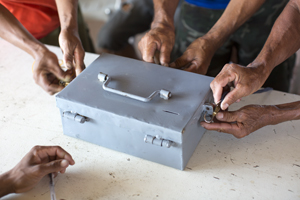
1107fWith at least 660 million people around the globe relying on the ocean for their livelihoods, and many living on the poverty line, Miriam Turner, Interface’s Assistant VP, Co-Innovation, saw an opportunity. Inspired by Aquafil’s recycling strides, she asked “Could we take this down to the community level and benefit some of the poorest people in the world? What if we could build a truly inclusive business model - buying discarded nets from local fishermen - giving them extra income - and cleaning up the beaches and oceans at the same time?”

Scoping a project of this magnitude requires a lot of hands, hearts and minds – so in 2011 the Co-innovation Team began assembling an army of collaborators, including the Zoological Society of London™ and marine biologist, Dr. Nick Hill. After intensive research and planning, they decided to focus the Net-Works pilot program within the 7,000 Philippine islands, on the Danajon Bank – in one of only six double reefs in the world.

And thus, Net-Works was born. The effects of clearing the beaches of nets isn’t just aesthetic. ”In an eco-system as delicate as the Danajon Bank,” Hill states, “discarded nets are incredibly destructive. The nets take centuries to degrade, and with a nylon density greater than that of water, the nets lie on the ocean floor where they do untold damage to marine life.”
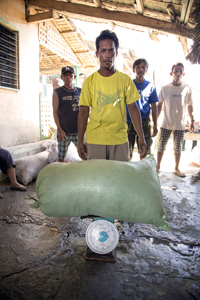
1004_fAlong with helping the villagers clean, sort and sell back the waste nets, Interface and the Net-Works partners have established community banking systems for the residents – supporting and strengthening the local, developing economy, and providing new financial opportunities for residents. Community banking empowers village members to establish forms of micro-insurance, savings and loans for the benefit of both individuals and the community.

Inclusive business is not philanthropy. It means profitable core business activities that take unconventional forms of partnership, expanding opportunities for poor and disadvantaged communities. It means building new models of materials sourcing to ensure the health and safety of our environment. It means beautifully designed products, crafted with care and purpose. And it means another step closer to achieving Mission Zero.

[Facebook] [LinkedIn] [Twitter] [Email]
Posted in Category NeoCon 2013, Net Works | Leave a comment

Jean Nayar

9 Top Trends in Hospitality Design

Ever ready to indulge their guests in a high-quality experience, restaurant and hotel owners—and the designers who shape their properties—constantly adapt to market demands and changing tastes to create inspiring hospitality settings. From a branding perspective, there’s more emphasis on design as a differentiator than ever before in today’s competitive global marketplace. These forward-looking tastemakers also often set the tone for trends in residential as well as commercial environments, such as healthcare settings and office space, which now embrace boutique hotel-inspired qualities, too. So what’s next on the hospitality front? We tapped three designers—Michael Suomi of Stonehill & Taylor, Patricia Rotondo of VOA Associates, and Angela Denney of FRCH Design Worldwide—for their take on what’s trending.


quote11. An emphasis on eco-friendliness.
“’Locavorism’ and social sustainability are gaining momentum,” says Michael Suomi. “I believe in the ability of the hotel industry’s collective buying power to boost local economies, and we want to do our part by advocating buying local. We also see more natural materials being used.”

2. Less pattern, more texture, and pops of color.
“In both public spaces and guest rooms, palettes are moving toward neutral tones, with bright accent colors and just one key pattern on carpet or a drapery or pillows,” says Angela Denney. “Patterns tend to be large-scale and often geometric in urban areas and organic in resort areas,” she explains. Denney also sees a movement away from traditional patterned Axminster carpets in hospitality settings. Instead, there’s a new “focus on asymmetrical patterns, that start strong at one end of a corridor and fade at the other,” she says. “Owners are now more open to carpet tiles in hospitality settings because of the diversity of options now, too.”

3. Seamless technology.
“Technology is being implemented in all hotels from the operations standpoint to the guest experience,” says Patricia Rotondo.“For example, with the push of a button a guest who couldn’t finish watching a movie on the plane during landing can finish watching it in his room,” she says. New technologies cut facility management costs, too, according to Denney. “Energy consciousness is important to owners, so more and more are exploring key card control points that manage lighting use, for example” she says.

4. A customized experience.
“Another huge trend is personalization,” says Suomi. “New concepts are evolving based on flexibility and individual needs. Hotels with just two to three rooms, pop-up hotels, and modular hotels are all new concepts being explored. The recession also changed attitudes toward spending money and in a continuation of this new attitude we are seeing that customers actually expect less service—the majority are happy with doing some of the service themselves,” he says.

5. Rarefied luxury.
“On the flip side, at the upper luxury level, guests are expecting to be pampered more,” says Suomi. “That also ties to the economy and how true luxury is catering to a much smaller and select audience,” he explains. Among the extras introduced at the high-end, says Rotondo, are “radiant-heat floors, TVs that convert to mirrors when not turned on, and guest baths with mirror defoggers—little things that make the guests want to come back.”

quote26. Celebrating local craftsmanship.
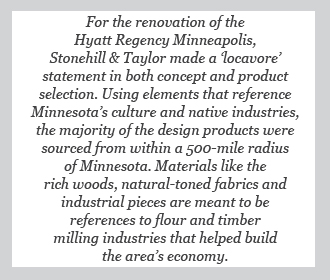
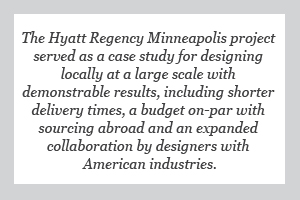
“Handwork and crafts in interior design used to be limited to small-scale projects,” says Suomi. “Nowadays, even larger projects incorporate craftsmanship to distinguish the design. There is a stronger focus on regionalism, so in our $25 million renovation of the Hyatt Regency Minneapolis, for example, we extensively researched producers, manufacturers, craftspeople, and artists in the area, and worked closely with them to achieve using products made domestically, mostly in the immediate area, in 80 percent of the furnishings, without any premium. This not only helps local economies, but also creates a nice emotional tie with the community,” he says.

7. Designer-driven branding.
“Brands follow designers now, not firms,” says Rotondo, who explains that “owners expect designers to go through a brand immersion process and once a designer is on board the client will continue to work with the designer, rather than the firm, if the designer moves on in order to keep the brand DNA intact.” Brands also adapt to context, says Rotondo. “For international projects, some cultures revolve around food—so the F&B component of the hotel is more important, others revolve around family, so the spaces have to have room for everyone. So now there’s also more freedom to use a boutique approach to each location.”

8. Multi-use spaces.
“Lobbies are now becoming multi-use spaces that can be used to serve breakfast during the day and host happy hours in the evenings,” says Rotondo. “As a result, seating and flooring respond to the use in these areas, with carpet and continental chairs going in the lounge-y spaces and hard surfaces and communal tables and chairs in dining areas.”

9. Bottom-line driven materials.
“Owners are looking to get more for less,” says Suomi. “This often translates into designers having to find new kinds of materials—on the maintenance side we are looking at creating highly engineered natural materials,” he notes. In the same vein, Denney is seeing more hard surface floors in guestrooms, “including larger-scale rectangular tiles and laminate floors that look like wood.”

Denney also said she’s “excited about Interface Hospitality’s new collection, which departs from traditional patterning and offers lots of different patterns and textures with combinations of cut and loop construction and lots of great colors as well as patterns with new twists on classic motifs like paisley.”


[Facebook] [LinkedIn] [Twitter] [Email]
Posted in Category Design Inspirations, Hospitality Design | Leave a comment

Jennifer Busch

Lessons Learned

Perkins+Will envisions a modular future for green education environments with Sprout Space™, part of the National Building Museum’s Green Schools Exhibit

In 2009, the Atlanta office of Perkins+Will entered Architecture for Humanity’s Open Architecture Network Challenge, which focused attention on poor education standards worldwide, and called upon the global design community to envision the classroom of the future. A concept designed by P+W’s Allen Post took the top award in the competition’s modular category, thus validating the firm’s lessons learned from years of experience designing sustainable K-12 school environments.

0582_Kittner_20130225_7649And6moreEnhancer-Edit

Perkins + Will’s award-winning, sustainable modular classroom, Sprout Space™, was built on the west lawn of the National Building Museum in Washington, D.C., as part of the NBM’s 10-month-long Green Schools exhibition.

“There are 250,000 modular classrooms in the United State, which means that roughly 7.5 million kids are learning in these spaces,” says Post, noting that traditional modular classrooms have long been disliked by Perkins+Will’s education practice. As the firm has designed and completed schools around

viagra canada

the country, its designers have lamented to see LEED-certified projects supplemented with sub-standard modular classroom buildings as school populations grew. “At best they are marginal. At worst they are unhealthy,” Post says.

The Architecture for Humanity competition offered Post the opportunity to devise a better solution—one that, four years later, finally has been realized in built form on the west lawn of the National Building Museum in Washington, D.C., as part of the NBM’s Green Schools, a 10-month long program and exhibition focused on greening the learning environment. Trademarked Sprout Space™, the sustainable modular classroom of the future is also finding its way into the real world as a pre-engineered building solution being marketed to the education sector through presenting sponsor Triumph Modular, and others.

According to Post, “healthy, sustainable, flexible” are the three pillars of the Sprout Space™ concept, with high indoor air quality, good acoustics, natural light, and efficient and functional space being the highest design priorities. In addition to featuring building materials, furniture, and finishes that are formaldehyde-free, eliminate harmful off-gassing, and include recycled content, Sprout Space™ incorporates glass walls and clerestories to allow daylight to flow in, uses energy- and water-efficient building systems (including a rainwater collection system), and employs a dynamic plan that can accommodate various teaching styles, seating configurations, and even outdoor learning opportunities—all in a unit comparable in size to a traditional double-wide modular classroom trailer.

T7424x4924-257_58_59_60_61_62_63Natural

“Healthy, Sustainable, Flexible” are the three pillars of the Sprout Space™ concept, which was designed by Perkins +Will to ensure high indoor air quality, good acoustics, ample natural light, and a dynamic plan that can accommodate various teaching styles and seating configurations, as well as outdoor learning space.

As Post notes, many manufacturing partners contributed to the success of Sprout Space™, including Interface, which supplied carpet tile for the entry and breakout areas. “We vetted all our partners carefully to make sure we were working with the leaders on sustainability in the industry,” notes Post. Interface’s contribution is multi-functional, serving as a walk-off carpet, providing a visual shift from installed hard surface flooring to indicate a spatial transition, and providing a softer flooring surface for students to sit in the breakout area.

In addition to being a feature of the Green Schools exhibit, Sprout Space is actually functioning as a working classroom for school visits during weekday morning hours,

T7424x4924-131_2_3_4_5_6_7Natural

Sprout Space™ designer Allen Post, from the Atlanta office of Perkins+Will, sought industry partners that are leaders in sustainability to help make the construction and interior fit out of the modular classroom space possible. Interface was tapped to provide the carpet tiles for entry and breakout areas.

According to the National Building Museum, “This 3-dimensional teaching tool is the first net-zero energy, high-performance, modular classroom available for distribution at a national level. Sprout Space™ integrates many active and passive green strategies in order to reduce operating costs, increase student and teacher satisfaction, and provide a healthier indoor learning environment.”

Interface also contributed carpet tile to the main part of the Green Schools exhibit inside the NBM, in a gallery devoted to hands-on learning about sustainable building and design materials for the K-12 education sector.

[Facebook] [LinkedIn] [Twitter] [Email]
Posted in Category Design Inspirations | Leave a comment

Jennifer Busch

We Are One

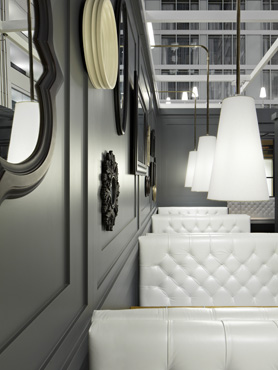
Gallerie Bar & Bistro detail at Hilton Columbus Downtown Atrium in Columbus, Ohio. Photographed by Nathan Kirkman

Gallerie Bar & Bistro detail at Hilton Columbus Downtown Atrium in Columbus, Ohio. Photographed by Nathan Kirkman

In the 10 years since they founded their young design firm, rising hospitality designers Lisa Simeone and Gina Deary of Chicago-based Simeone Deary Design Group can count such projects as Chicago’s elegant Elysian Hotel (now the Waldorf Astoria Chicago), the Hilton Dallas Park Cities, and the JW Marriott Indianapolis to their credit. Currently they are working on Loews hotels in Chicago, Nashville, Tenn., and Orlando, a new restaurant concept with Richard Melman of Lettuce Entertain You fame, and a JW Marriott and a Westin for White Lodging in the red hot city of Austin, Texas. They’ve also started a residential design studio. Interface talked to this busy pair—who approach their work as a team—about the formula for success behind their prospering firm, their fascination with technology, and the all-important role of design in the hospitality sector.

IF: How would you describe your design process?

LS & GD: After we meet with the client and understand their criteria, we do research on the location, the building architect…we dig into the property to find out what is going to make it grow in the community. For us a project is as much a branding and positioning exercise as it is an interior design assignment.

14 Brush Creek Ranch Inspiration ImagesWEB

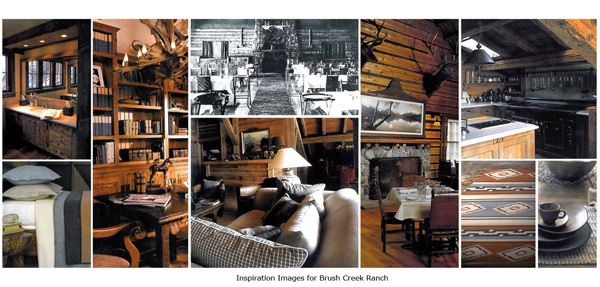
Brush Creek Ranch inspiration images

We start our critical thinking by digging into the location, and then we create a concept that is really representative of what we are thinking. That’s when we get very creative. We open up our minds to what inspires us, and we filter all this through our story.
We make very succinct decisions around every element in every phase. This elevates us above trends, so we are creating a sense of place and not just a sense of currency.

IF: Where do you turn for inspiration?

LS & GD: Inspiration comes from everywhere! It comes from fashion, jewelry, metalwork, film noir, Hollywood. Anything we find in culture we can use. We have been inspired by Jane Austen, pin-up girls, architecture, nature. We are really into how people lived at certain times. For each project we run these ideas through the filter of our concept and see how things settle out.

IF: What do you enjoy most about your work?

GD: I most enjoy the people I work with, and watching them grow and mature, and thinking that Lisa and I are helping that happen. Also, I am exposed to so many people and places and ideas and things. It makes me a much better designer and helps me grow too.

LS: I am inspired every day working with such a creative group of people. We have such a sense of camaraderie here. Being inspired and inspiring other people is what gets me up every morning.

IF: What do you believe to be the primary value of good design to your clients?

LS & GD: Design is how our clients touch their customers. The experiences we create for them help them reap monetary benefits. Are clients seeing proof in the numbers? They are! If we do a great design, that design becomes a marketing tool.

IF: Is there anything in particular happening in the design world right now that inspires you?

LS & GD: Technology. It moves so fast. The doors are flung open on the things we are able to achieve. It has become a real vehicle for expressing ideas.

IF: What is

buy viagra no prescriptions

the biggest challenge facing the design profession today?

LS & GD: The biggest challenge is the speed at which projects are being built and financed. How do designers keep up with that? The creative process isn’t given enough time. Our own challenge is how to morph our process to be just as competitive and creative, and still fit into that excelled, demanding way of doing business.

IF: If you were able to give one piece of advice to young designers just starting out, what would it be?

18 Gina Deary HeadshotWEB2GD:
Everything is a learning experience. School opens the door but once you walk through that door there is a lot you still have to learn. Nothing is beneath you. Get every experience you can. And don’t be afraid to fail.

19 Lisa Simeone HeadshotWEB
LS:
Try to intern as much as possible. Understand the many different types of firms and facets of design. There is a lot of pressure to conform but be true to yourself. Don’t be timid. Let the bold idea out.

[Facebook] [LinkedIn] [Twitter] [Email]
Posted in Category Designer Spotlight | Leave a comment

Melissa Vernon

Clinton Global Initiative University Turns Ideas into Actions

Why should we care about anybody else? Former President Clinton believes that caring about others is imperative, “because we live in an interdependent world. Our fates are bound up together. If you want a future of shared prosperity, everybody has to be a part of it.”

On April 7th Interface chose to

viagra

be a part of creating the future by partnering with the Clinton Global Initiative to host a service project during the annual CGI University conference. Standing alongside hundreds of highly motivated college students from all 50 states and more than 70 countries, sharing stories of how they have tackled sustainability, was a humbling experience. To attend students must have developed a Commitment to Action, “a specific plan of action that addresses a pressing challenge on campus, in the community, or around the world.”

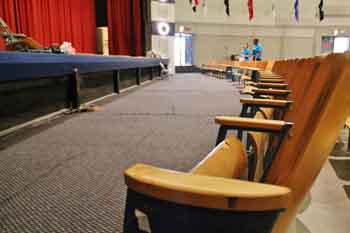
Gateway STEM High School, St. Louis. MO.

Gateway STEM High School, St. Louis. MO.

For weeks, volunteers from Washington University in St. Louis, MO, were busy preparing Gateway STEM High School, a St. Louis magnet school, for the service projects. A flurry of activity surrounded the school - old carpet was removed, painter’s tape lined the walls, supplies were stocked - anticipating the arrival of hundreds of student volunteers and a few VIP guests.

Chelsea and President Clinton kicked off the day with inspiring messages of the power of service and civic engagement. They highlighted the enormous employment opportunity for the American workforce in careers in energy efficiency, green schools, and retrofitting buildings. Gateway STEM high school integrates a strong academic curriculum of science, technology, engineering and math - skills needed for our current and future economy.

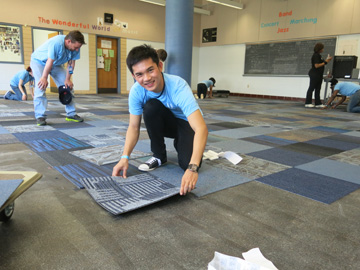
After two days of inspiring panel sessions, skill building breakout sessions, and top notch networking, hundreds of students joined in transforming Gateway High in a number of restorative projects around the school and grounds – painting, carpeting, garden construction, storage clean-out, and more.

Interface’s Director of Sustainable Strategy, Melissa Vernon, and St Louis based Account Executives Dennis Upshaw and Katie Sweetin, led a motivated group of students installing carpet in the music room and college room. The students quickly learned the technique and really enjoyed their volunteer experience. Flooring Systems, a flooring dealer in St. Louis, donated their time to prep the floors and installed the auditorium carpet to have it looking great for President Clinton’s welcoming remarks.

carpet installationweb

From eyesore (and tripping hazard) to restored beauty.

The teachers and staff of Gateway High School were thrilled with the result. The previous carpet in the auditorium was a tripping hazard with wrinkles and duct tape everywhere. Principal Dr. Beth Bender commented, “I have literally had staff in tears and students just shocked at how great the carpet in the auditorium looks, as well as the college and band rooms. For those us of in public education, especially the poorer end of the spectrum, this makes a huge difference.”

In his thanks President Clinton commented, “I’d like to thank Interface carpet, which donated time and supplies to completely re-carpet this auditorium with environmentally friendly modular carpet tiles.” He also mentioned the great work of the USGBC and the Center for Green Schools.

The teachers shared that the students don’t receive many gifts. An upgrade to the building honors these individuals as valued members of society. As President Clinton voiced, “schools like Gateway are giving people a chance to climb up the ladder in this country… they’re [Gateway students] being given a chance to succeed in a world where the doors have been shut to many of their parents because they didn’t have those opportunities.”

Interface was proud to be a part of this special day for the CGIU team and to leave a legacy for the Gateway students.


[Facebook] [LinkedIn] [Twitter] [Email]
Posted in Category Sustainability | Leave a comment