



The San Francisco Planning and Urban Research Association (SPUR) does its part to encourage informed public dialog about urban development in the Bay Area. Helping it set an example for responsible development is a LEED-certified headquarters designed by Pfau Long Architecture.
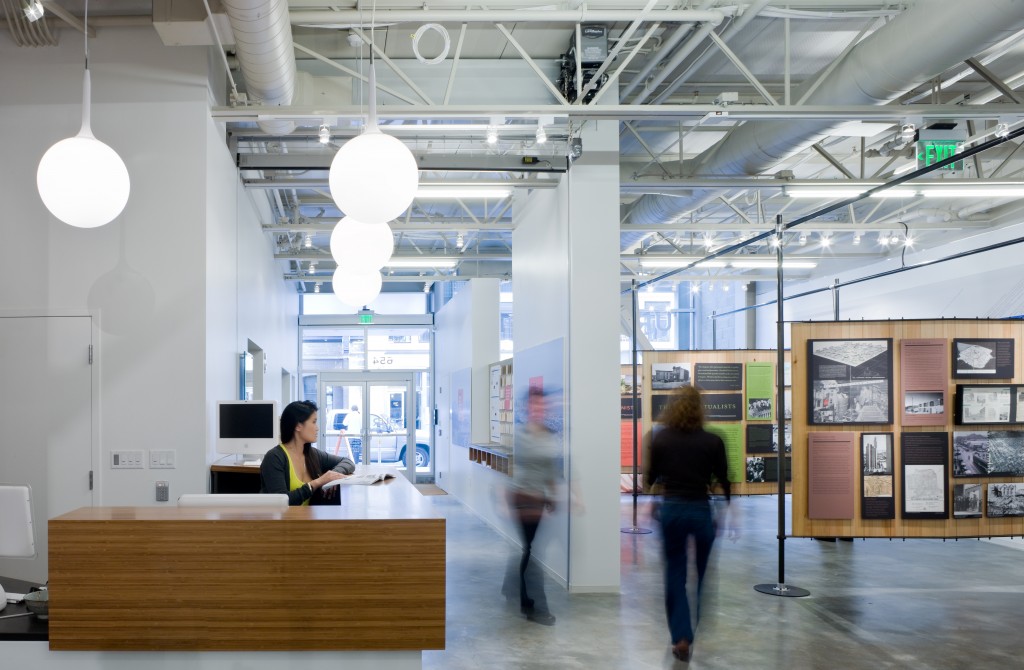
SPUR, a broad-based think-tank organization that promotes good planning and good government through research, education, and advocacy, was living in overcrowded conditions in a nondescript building in an isolated location in San Francisco when its board of directors voted to relocate to a new home that would improve SPUR’s visibility and access to the public. “They really felt they had to make a choice about the future,” says SPUR director Diane Filippi. “The move was a metaphor for the organization to expand its mission.”
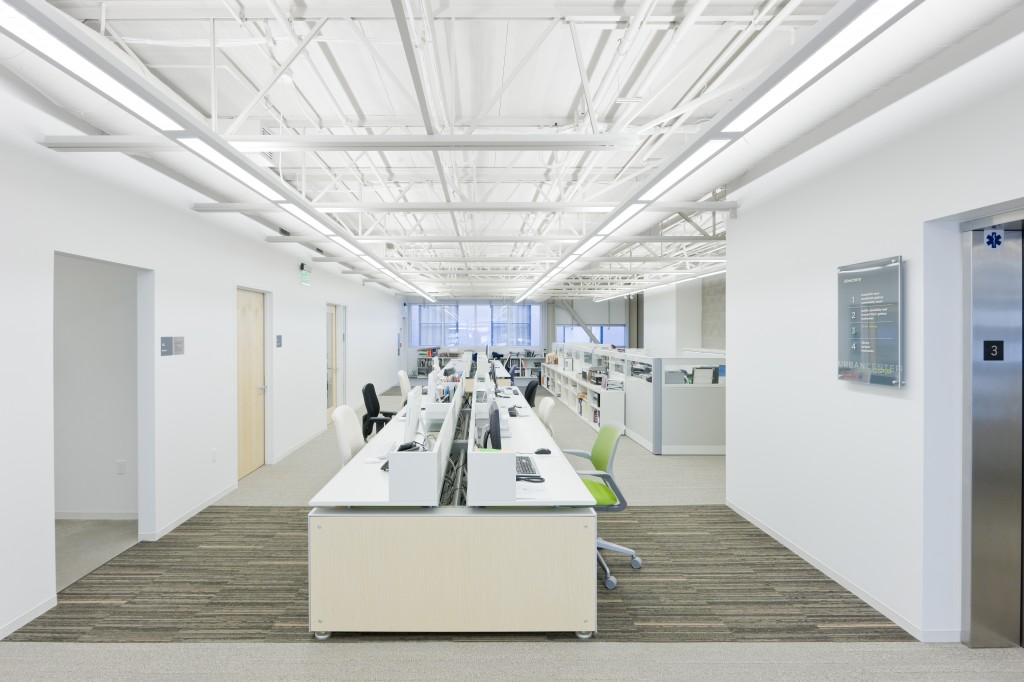
To communicate its expectations, the building committee provided San Francisco-based Pfau Long Architecture with a list of descriptive terms such as transparency, visibility, presence, lightness, welcoming, accessibility, function, flexibility and sustainability. Then it was up to architect Peter Pfau and his team to figure out how to efficiently deliver the required functions into a tight footprint and on a tight budget. The need to accommodate exhibition, public gathering, work, and research spaces, as well as support services, in a deep, narrow floor plate dictated a building with stacked functions and active vertical circulation to tie them all together.
Yet addressing the functional needs was only part of the challenge. “There was always this notion of transparency,” Pfau explains. “SPUR makes the public process in San Francisco visible and subject to discussion”—and that mission was quite literally translated into architecture. On a heavily trafficked section of Mission Street known for its high-profile museums, including Libeskind’s Jewish Museum and the Museum of the African Diaspora designed by Freelon Architects, SPUR’s glass and metal façade, bright orange signage, and tower of backlit translucent glass allows copious amounts of natural light into the interior space and serves as a beacon to attract public attention. “The new building has completely changed the demography of SPUR members,” says Pfau. “There has been a 75 percent increase in participation among young people who want to make cities better.”
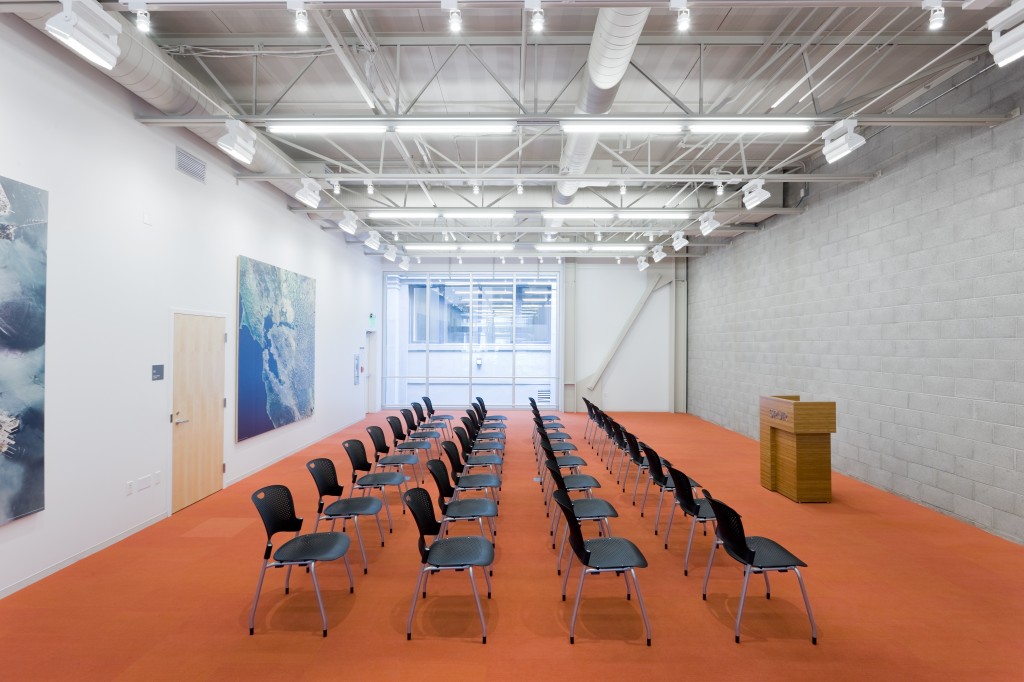
The interiors are spare and simple, the result of both a tight budget and the need for maximum flexibility. Block walls, steel tresses and basic materials create a neutral backdrop, allowing nearly every part of the building—walls, floors and ceilings—to be used as exhibit space, while pops of bright color, including orange Interface carpet tiles in the second floor multi-purpose room, add interest. Interface also supplied the carpet for the third floor staff work area and the fourth floor library. “Everything is pretty much what it is,” notes Pfau. “There is a straightforwardness and an honesty about how it goes about doing what it does. That was the driver for the aesthetics.”
“This building has enhanced everything,” comments Filippi. “Our work has gotten better, and the community at large is even more focused on what we do.”
Photography by Iwan Baan
Excerpted from an article that appeared in the April 2010 issue of Contract
![[Facebook]](wp-content/plugins/bookmarkify/facebook.png)
![[LinkedIn]](wp-content/plugins/bookmarkify/linkedin.png)
![[Twitter]](wp-content/plugins/bookmarkify/twitter.png)
![[Email]](wp-content/plugins/bookmarkify/email.png)


